
Verona
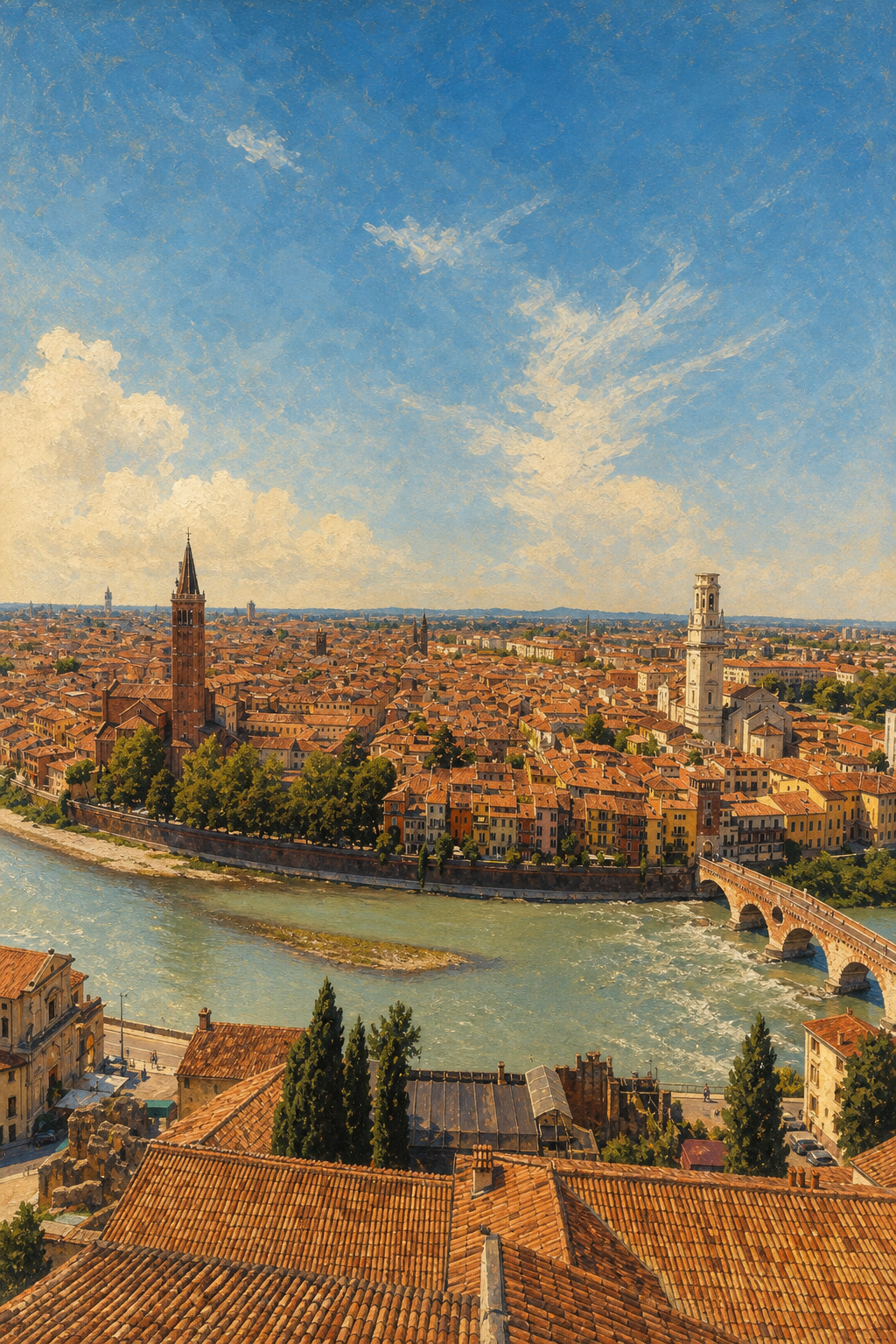
Why choose Verona?
- Who it fits best: Solo
- Best time to go: Summer
- Ideal stay: 2-4 nights
- Walking: Part of the experience
- Surroundings: Worth exploring
Verona at a glance
A quick read on how well this destination fits different kinds of trips.
Who it fits
- Solo
- Couple
- Friends
- With kids
Best time to go
- Autumn
- Winter
- Spring
- Summer
How long to stay
- 2-4 nights
- 5-8 nights
- 9-14 nights
Verona insights
Takeaways from real traveler experience in Verona.
- Walking
- Part of the experience
- Surroundings
- Worth exploring
- Upscale options
- Many
- Scale
- Compact
- Planning
- Recommended
- Variety
- Broad
Discover more destinations
More from the same country, or something with a similar character.
Other destinations in Italy
Discover more about Verona
Practical and interesting facts about the destination.
Verona combines materially different experience families: Roman and medieval heritage, Renaissance and fortified urban fabric, museums and churches, food and wine, river and hill viewpoints, cycling/walking, nearby Lake Garda, Valpolicella, Soave and Lessinia. The official tourism board explicitly presents both city and surrounding-area itineraries.
Verona has accessible calm settings, but the normal central visitor experience is urban, social and sightseeing-oriented rather than uniformly low-intensity. Restorative alternatives include river walks, hill viewpoints, churches, gardens, nearby vineyards, Lessinia and Lake Garda.
Verona has visible public social life through piazzas, markets, cafés, wine bars, restaurants, aperitivo settings, cultural venues and recurring events. Official destination material specifically highlights food-and-wine traditions, wine bars, local lifestyle and a full events diary.
Verona supports cost-conscious sightseeing through extensive walking in the compact historic core, churches and public spaces, and a Verona Card that bundles admission to major sights with optional urban transport. The official page lists the card’s included attractions and validity periods.
The historic centre contains a dense concentration of attractions, public squares, churches, museums, restaurants and pedestrian routes, making a fixed-base central stay operationally straightforward for a basic Verona visit. UNESCO describes a coherent historic urban structure, and the tourism board provides maps, tickets, transport information and a year-round tourist office.
Crowd pressure is likely concentrated in identifiable hotspots—Piazza Bra/Arena, Juliet’s House, Piazza delle Erbe and core pedestrian streets—rather than uniformly across the entire UNESCO property. UNESCO describes a large historic urban area with multiple districts, river crossings, monuments and fortified structures.
Verona has a documented premium hospitality and dining layer. The 2026 MICHELIN Guide identifies Casa Perbellini – 12 Apostoli in Verona among Italy’s three-star restaurants, demonstrating access to an internationally elite dining experience.
Verona provides several forms of liveliness beyond nightlife: busy piazzas and aperitivo culture, public markets, theatre and opera, festivals, food-and-wine events, museums, shopping streets and scheduled cultural programmes. The official tourism board describes a full events calendar covering Verona, Valpolicella, Lessinia, Soave and the Veronese plain.
Based on real traveler preferences (Stravl data)
Looking for something else?
554 destinations across 44 countries. Search by name or filter to browse.
Click a country to see its destinations
Want to find your own destination?
Take the quiz and see which destinations fit your mood right now.