
Summer · editorial guide
Donousa: beaches, trails and days without a schedule
By The Tripsenti Team
Donousa is one of those small islands where you can choose just how quiet you want your holiday to be.
You can stay in Stavros, with the beach only a few steps from your room, food and cafés around you and people out in the evening. Or you can head towards Messaria, Mersini and Kalotaritissa, walk the old trails and spend a large part of the day on a beach away from the main settlement.
The island covers around 13.5 square kilometres. The main road connecting Stavros with Messaria, Mersini and Kalotaritissa is about 13 kilometres long, but Donousa is much better discovered if you leave part of that distance for walking. Five marked trails follow old island routes and lead to beaches, springs, old mines and small settlements.
That gives it a good balance. You do not have to isolate yourself to find peace, but you also do not need to stay in the same place all day to keep the pace slow.
Why Donousa works for a quieter holiday
Stavros makes everyday life especially simple.
It is the island's port and main settlement. Most accommodation, tavernas, cafés and bars are concentrated here, while the sandy beach lies right beside the village and can be reached on foot from anywhere in the settlement.
That means you can spend an entire day without travelling anywhere at all. A swim in the morning, back to your room, lunch, and then the sea again in the afternoon.
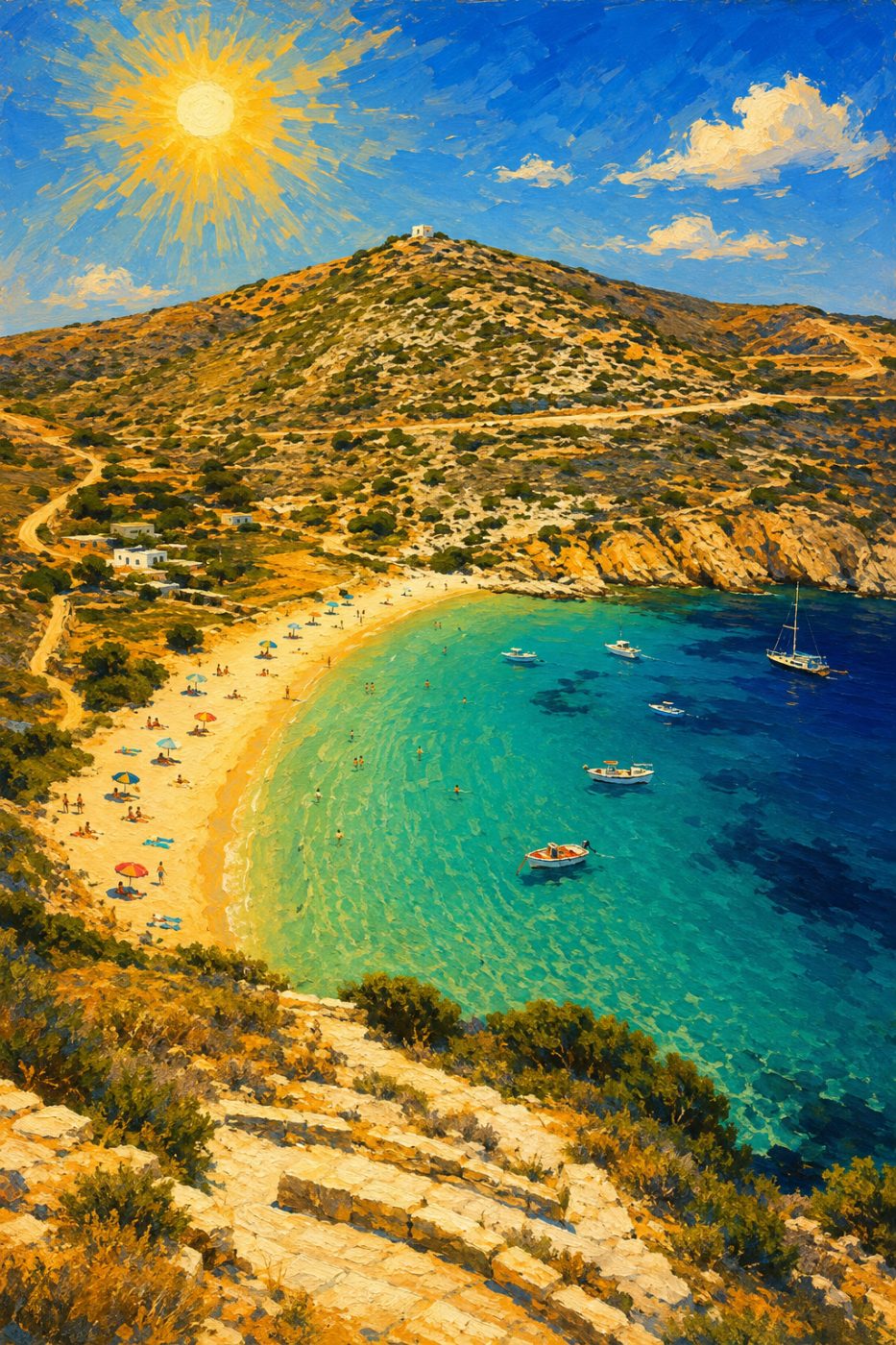
When you want a change of scenery, Kedros is the natural first step. It is a sandy beach in a sheltered bay, reached from the road and then by a short stone paved path. A trail also connects it with Messaria.
Farther east, Mersini leads towards Livadi and the small beach of Fykio. Livadi has white sand, turquoise water and tamarisk trees for natural shade. From Mersini it is about a half hour walk along a trail that also passes the village spring and its large plane tree.
At the north eastern end lies Kalotaritissa. It is a small settlement at the foot of Papas, the island's highest summit, and around its bay are small beaches such as Sapounochoma, Vlycho and Mesa Ammos. A taverna also operates in the settlement during summer.
So you do not have to choose between 'quiet' and 'something to do'. You can start in a lively settlement and, within the same day, find yourself in a much quieter part of the island.
What summer offers on Donousa
Stavros is the easiest base for most travellers.
As well as the beach and most services, several trails begin here. The longest marked route reaches Kalotaritissa. It is about 4.4 kilometres long and takes roughly one hour and fifteen minutes to one and a half hours. Along the way you see the open Aegean, old mining installations and Papas.
Kedros is one of the island's most characteristic beaches and also has a small piece of history beneath the water. Remains of a Second World War shipwreck can be seen on the seabed of the bay. A path also starts from the beach towards Kato Mylos, following an old route once used by residents to transport grain.
Mersini is worth visiting even if you do not continue on to a beach. The natural spring and large plane tree create one of the most unusual scenes on such a dry Cycladic island. From there you can descend towards Livadi and Fykio.
Kalotaritissa is the choice for the day when you want to move farther away from Stavros. Vlycho is usually protected from the wind, while Mesa Ammos is the largest and most remote of the beaches around the bay.
And if you want a day that does not revolve around a well known beach, there is the trail from Stavros towards Limni and Aspro Kavo. In about 40 minutes it leads to the western side of the island, first to a small enclosed cove and then to one of Donousa's steepest and most open landscapes.
Local festivals and summer celebrations
Donousa has only a few festivals, but they are quite characteristic.
On 15 August, the festival of Panagia takes place in Stavros. Residents and visitors to the island take part, along with people from the surrounding Small Cyclades. The celebration is held at the port with food, wine and live music and continues until late.
September has two more important dates. The Holy Cross is celebrated in Stavros around 14 September, and a few days later Agia Sofia is celebrated in Mersini, close to the spring and the plane tree.
If your main aim is absolute quiet, 15 August is not the most representative moment to find it in Stavros. But if you want calm days and one evening when the whole island gathers in the same place, it can be part of the experience.
When to go
In May, the average high in the area is around 22°C and the average low about 15°C. It is a very good period for the trails and longer routes. If, however, your main goal is to swim every day, May remains more of a transitional month than a fully established summer period.
In June, the average high rises to around 26°C and the low to 19°C. It is one of the best periods for combining the sea and walking before the peak of summer traffic.
In July and August, average highs in the area are around 26 to 27°C and lows around 22°C. This is the heart of summer and the period when Stavros, Kedros and the best known beaches become livelier.
The meltemi matters here as well. Long term figures for Naxos show stronger average winds in July, August and September. On Donousa this affects not only swimming but walking too, as the official guide warns of strong gusts on exposed sections of some trails.
In September, the average high remains around 25°C and the low close to 20°C. It is perhaps the period that best fits this particular feature. You still have summer days, more comfortable conditions for walking, and two of the island's traditional festivals during the month.
In October, the average high drops to around 21°C and the low to about 17°C. It is a better season for walking and a genuinely slow pace than for a classic beach week. Because Donousa is a small seasonal destination, it becomes more important at this time to check which services are operating on your travel dates.
The temperatures above are indicative long term values for nearby Naxos, not measurements or a forecast for Donousa.
For groups
Stavros is the most natural base.
You can have the beach, food and drinks without any journey and choose the days when you want to head out to Kedros, Livadi or Kalotaritissa. There is social life in the evenings, but the centre remains a very small settlement rather than a large nightlife district.
That makes Donousa a good choice for a group that does not want to spend the holiday completely isolated, but also does not need clubs and lots of different options every night.
For families
Stavros is also the most practical base here.
The beach is within the settlement, sandy and naturally shaded in places, and the Municipality's official guide considers it suitable for families with young children. At the same time, most of the island's services are right beside you.
Vlycho in Kalotaritissa is another interesting option, as it lies right beside the road and usually has calm water.
With younger children, I would treat Livadi and some of the more isolated beaches differently. They are beautiful, but access involves walking and you need to bring water, shade and anything else the family will need for several hours.
For couples
Donousa particularly suits a couple that wants a quiet holiday without disappearing completely from social life.
You can stay in Stavros and walk towards Kedros, devote one day to Mersini and Livadi and another to Kalotaritissa. In the evening you return to a place with options for food and drinks, without needing to travel again.
This is perhaps where it differs most from some of the previous islands in the series. Peace does not require choosing isolated accommodation or organising the entire day around getting away from other people.
For solo travellers
Stavros is also a very good base for a solo trip.
You arrive by ferry and are already in the place where accommodation, food, the beach and most social life are concentrated. Trails start from here, and you can organise several days without a car.
The five marked trails vary in length and difficulty, from around half an hour to an hour and a half. That means every walk does not have to become a major day activity. It can simply be the way you get to the beach.
And because evening life returns mainly to Stavros, a solo trip does not necessarily mean being alone all day.
What to consider before booking
Donousa has no airport and can only be reached by sea.
Naxos is the most practical intermediate hub, with ferry connections to Donousa, while during the summer there are also services from Piraeus. Visit Greece also identifies Naxos as the main air and ferry hub for reaching the island. Exact schedules change, so they need to be checked for your specific dates.
There is no taxi on Donousa. During the peak months, a local minivan runs frequent services to the beaches, and sea transport around the island is also available.
There is also no bank, and there is one ATM in Stavros. The official guide also notes that there is no petrol station. These things do not greatly affect someone arriving without a vehicle for a few days, but they show the scale of services you should expect.
If you want to do a large part of the trip on foot, you need to take the heat and wind into account. The trails are not especially long, but some have steep sections and exposed points. In July and August, I would do the longer routes early in the morning or later in the afternoon rather than in the middle of the day.
And in August I would book accommodation earlier. Donousa remains a small island with a limited number of places to stay, so an increase in visitor numbers is more noticeable than it would be in a larger destination.
Ταιριάζει αν
- You want a peaceful holiday but do not want to feel isolated.
- It suits you if you like having a simple base with the beach, food and people around you, while being able, whenever you feel like it, to walk or make a short journey to much quieter stretches of coast.
- And it suits you especially if walking is not, for you, 'an activity that has to be planned', but simply an enjoyable way to move from a village to a beach.
Ίσως όχι αν
- You want a wide range of shops, organised activities, intense nightlife or the certainty that transport will be available at any moment.
- Also, if you choose August only because you imagine an almost empty island, you may be disappointed. Stavros and the best known beaches are busier at the height of the season.
- Donousa does, however, have one advantage: you do not have to go far for the pace to change. You can have company and life around you in the evening and, the next day, walk to a beach where the schedule ends the moment you arrive.