
Summer · editorial guide
Lesvos: a large island, local life and reasonable costs
By The Tripsenti Team
Lesvos is one of those islands where the place you choose to stay can significantly change the nature of your trip.
Mytilene offers one kind of experience, with a town, museums, shops and more nightlife. Molyvos and Petra in the north offer another, with beaches and a more classic island atmosphere. Plomari combines the sea with the tradition of ouzo, Skala Kallonis brings you close to the gulf and wetlands, while Skala Eresou has a long beach, tavernas, cafés and a more relaxed pace.
This also matters for cost. There is no single area where you absolutely have to stay in order to enjoy the island. Depending on the season, the type of accommodation and how you want to spend your days, you can compare several different bases.
Why Lesvos offers a good balance between experience and cost
Lesvos has year-round life that is not limited to seaside tourist areas. In Mytilene and in the villages you will find bakeries, traditional cafés, ouzeries, tavernas and local shops that also serve island residents. This does not mean that food is cheap everywhere, but it does mean there are more options beyond a narrowly tourist-focused market. The local cuisine has a character of its own, with Kalloni sardines, ladotyri cheese, olive oil, seafood and, of course, ouzo.
A large part of the day can also be built around things that do not require an organised programme. Lesvos has 459 kilometres of coastline, with beaches such as Petra, Vatera, Skala Eresou, Agios Isidoros and many smaller shores. There are villages for strolling, walking routes, the salt pans and wetlands of Kalloni, and major changes in landscape as you move around the island.
If you want to add something more, there is the Petrified Forest and the Natural History Museum in Sigri, the thermal springs, and museums in Mytilene and inland. The point is that the entire trip does not need to depend on paid activities.
What summer gives you on Lesvos
Lesvos can become a very different trip depending on where you choose to move around.
In the north, Molyvos and Petra combine the sea, settlements, food and evening walks. In the south, Plomari has its own identity built around ouzo, old industrial history and nearby beaches. In the west, Skala Eresou and Sigri can be combined with the Petrified Forest and a more open, dry landscape. In the centre of the island, Kalloni gives access to the wetlands, salt pans and many routes towards other areas.
And then there is Agiasos. Built on the slopes of Mount Olympus at an altitude of about 460 metres, it is a traditional settlement that offers a completely different picture from seaside Lesvos.
Festivals and summer celebrations
If your dates are flexible, it is worth looking at what is happening on the island during the period you plan to visit.
On 15 August, Agiasos is one of the most important gathering points on the island. The celebration of the Virgin Mary attracts large numbers of worshippers and festive events, completely changing the atmosphere of the mountain village.
Every year Skala Kallonis hosts the Sardine Festival, usually around the beginning of August. Kalloni sardines, ouzo, music and dancing are at the centre of a celebration with a history of roughly three decades. The exact dates change every year, so it is worth checking them before you book.
In July, Ouzo Fest usually takes place in Mytilene and Plomari, with ouzo producers, local meze and live music. In August, Molyvos also hosts the Molyvos International Music Festival, a classical music institution that has been running since 2015.
There are also smaller local celebrations that can become a reason for a trip across the island, such as the Cheese Festival in Mantamados and the Trahanas Festival in Akrasi in August.
When to go
May has mild temperatures, with an average high of about 24°C and an average low of 15°C. It is more of a month for villages, routes, nature and exploration, with the sea gradually becoming part of the programme as the end of the month approaches. Lesvos has extra interest at this time because spring is an important season for the wetlands and birdwatching.
In June, the average high rises to about 29°C and the low to 19°C. Summer has now properly begun, but temperatures are generally milder than in July and August. It is a good period if you want to combine beaches with Molyvos, Agiasos, Plomari, the Petrified Forest and longer drives around the island.
July and August are the hottest months. The average high is around 30°C and the average low around 21 to 22°C. This is the period with the liveliest summer atmosphere, more festivals and events, and greater activity in the best-known seaside areas.
In September, the average high remains around 27°C and the low around 19°C. It is still a month well suited to the sea, while also making routes inland easier. If you are not particularly interested in the peak of summer activity, it is worth comparing September with August in terms of accommodation too.
In October, the average high falls to about 22°C and the low to 15°C. There can still be days suitable for swimming, especially at the beginning of the month, but the weather becomes more changeable. At this time of year, Lesvos is better suited to a trip focused on villages, nature, local food, thermal springs and routes rather than a classic holiday devoted exclusively to the sea.
For groups
Mytilene is the most obvious base if you want more nightlife, bars, ouzeries and food choices. Plomari combines a beach, tavernas and a stronger connection with ouzo and gastronomy, while Skala Eresou has cafés and bars right beside its long beach. If you have a car, a group can easily build each day around different routes instead of staying in the same area all the time.
For families
Petra is a practical choice because it combines a long sandy beach, organised facilities, restaurants and a playground. Skala Kallonis has a sandy shore and shallow water, while Kanoni in Thermi is specifically mentioned by Visit Lesvos as suitable for families with small children because of its shallow waters.
For a family, choosing the right base matters especially. The island is large, and there is no need to try to see all of it in one week. An area with a beach, food and everyday essentials close to the accommodation can make the days much simpler.
For couples
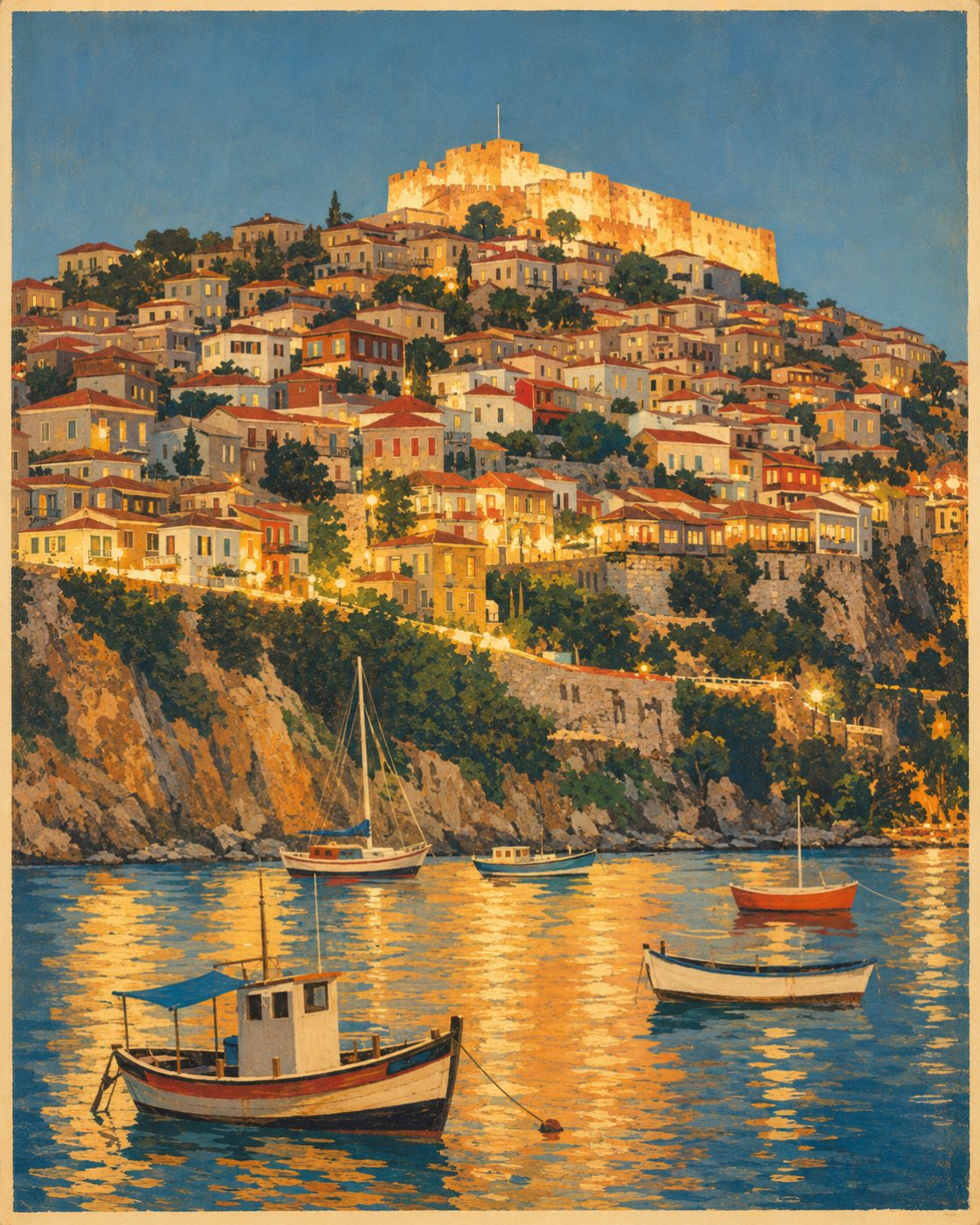
Molyvos and Petra are an easy combination for those who want a beach, walks and food without needing a long transfer every evening. The castle above Molyvos, the traditional settlement and the views over the Aegean give northern Lesvos a distinctive character.
For something more relaxed, Skala Eresou combines a long beach with tavernas and bars beside the sea. If your interest is more in food and routes, Plomari can be a base for the southern part of the island.
For solo travellers
Mytilene is perhaps the most practical starting point if you want to have a town, cafés, food, museums and life around you throughout the day. It is also a base from which you can get to know the island gradually, without your accommodation itself needing to be in an isolated seaside spot.
Skala Eresou is a different option if you prefer to be beside the sea but still have tavernas, cafés and bars within a short distance. For someone travelling alone who enjoys walking, Lesvos also has an organised network of walking routes in many parts of the island.
What to calculate before you book
The main trade-off of Lesvos is its size.
If you want to explore the north, south and west of Lesvos on the same trip, you will spend a fair amount of time on the road. Car rental, fuel or the cost of taking your own vehicle should therefore be included in the overall calculation rather than treated as a minor detail at the end.
This does not mean that a car is needed for every type of trip. If you choose a base such as Mytilene, Petra, Plomari or Skala Eresou and want a more settled holiday, you can significantly reduce everyday driving. But if you really want to see the different sides of the island, having the freedom to move around adds a lot.
The season matters too. In popular areas, prices may be higher when demand is stronger. If you have flexibility, it is worth comparing the same areas and properties in June or September instead of assuming that the picture from one particular week represents the whole summer.
Ταιριάζει αν
- You want your holiday to combine the sea, villages, food, nature and local life, and you do not mind making some drives to discover different sides of the island.
- It also suits you if you like having a choice of where to stay and deciding for yourself whether a day will simply mean a beach and a taverna or a longer route with villages, museums and nature.
Ίσως όχι αν
- You want a small island where almost all beaches and settlements are close to one another.
- Also, if your aim is to see as much as possible but you do not want to drive or organise transport at all, the size of Lesvos can make the trip more demanding.