
Summer · editorial guide
Samos: green landscapes, beaches and Samian wine
By The Tripsenti Team
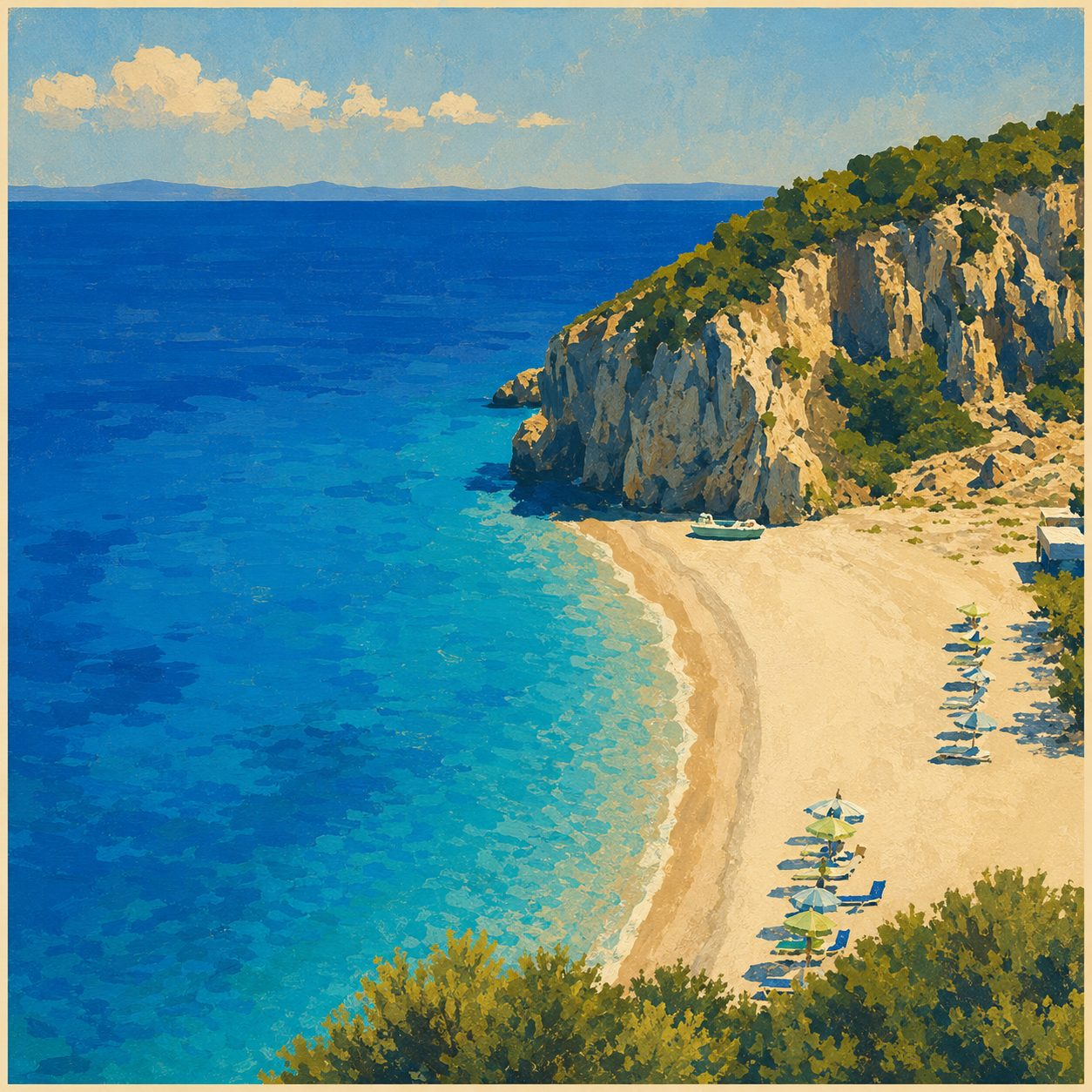
Samos is one of the Greek islands where the sea is only one part of the trip.
Behind the beaches rise mountains, forests and vineyards. On the slopes are villages such as Manolates, Vourliotes and Pyrgos, while on the southern side Pythagoreio and Heraion connect a summer holiday with a history that reaches back to ancient Samos.
On the coast, you can stay beside the sea and have restaurants and evening walks close by. Inland, you can spend the day among villages, trails, waterfalls and vineyards. And on the western side the landscape becomes wilder, with Mount Kerkis, Potami and the Seitani beaches.
This variety is one of Samos’s strengths. Not every day of your holiday needs to look the same, and not every different experience has to be an organised excursion.
Why Samos offers a good balance between experience and cost
Samos gives you several ways to fill the day without needing to pay for an activity every time.
You can spend a morning at a beach and the afternoon in a mountain village. You can combine Pythagoreio with Heraion and the Tunnel of Eupalinos. You can start from Potami and walk towards the waterfalls or head towards trails in western Samos.
Pythagoreio and Heraion have been on the UNESCO World Heritage List since 1992. In the same area is the Tunnel of Eupalinos, the ancient underground aqueduct of the 6th century BC.
There is also a more everyday side to the island. Samos Town, Karlovasi and the larger villages have year-round life, a market, cafés, bakeries and restaurants. This means that food and going out are not limited exclusively to the most tourist-oriented seaside areas.
And there is the wine. Viticulture remains active in around 25 villages, mainly on the slopes around Mount Ampelos. The vineyard terraces form part of the landscape itself, and Muscat of Samos is one of the products most strongly associated with the island.
So you do not need to add a lot to the programme in order to feel that you have seen different things. A beach, a village, a trail, food and a route through the vineyards can by themselves make a full day.
What summer gives you on Samos
The north coast is one of the greenest parts of the island. Lemonakia, Tsamadou and Tsabou lie in a landscape where vegetation comes almost down to the sea. Kokkari can work as a lively base, with a beach, restaurants and evening walks, without needing to organise the entire trip around it.
A little farther inland are Vourliotes and Manolates. Here the picture changes quickly. From the coast you move to green slopes, vineyards and villages where you can stop for food or simply take a walk around the square.
In the south, Pythagoreio combines the harbour, beaches and archaeology. You can visit the Archaeological Museum or the Tunnel of Eupalinos, head towards Heraion and later return to the harbour for food and an evening walk.
Nearby is Potokaki, a long beach with organised sections, tavernas and opportunities for water sports.
Towards Karlovasi, Potami Beach can be combined with the well-known waterfalls in the area. Routes towards Mikro Seitani and Megalo Seitani, two of Samos’s most characteristic natural areas, also begin from the western side.
In the south-west, Ormos and Kampos Marathokampou, Limnionas and the surrounding shores offer a quieter pace, with greater emphasis on the sea and less on the activity of the better-known seaside settlements.
And as you climb inland, Samos changes again. Pyrgos, Manolates, Vourliotes and the smaller villages bring squares, vineyards, forest and local food into the trip.
Festivals and summer celebrations
Samos has a lively summer calendar, and several celebrations are directly connected with the villages and local production.
On 27 July, Kokkari hosts the festival of Agios Panteleimonas. In Koumeika, on 5 August, the eve of the Transfiguration of the Saviour, one of the island’s traditional festivals takes place, while in Mytilinioi there is a major celebration around 15 August.
On 6 August, Pythagoreio celebrates the Transfiguration of the Saviour. The date is also connected with the anniversary of the Battle of Samos and is accompanied by official and local events.
Wine also has its own place in the summer calendar. During July and August, Wine Festivals are organised in different parts of the island, with Samian wine, local food and music.
At the same time there are events of a different kind, such as the Ireon Music Festival in Heraion, the Samos Young Artists Festival in Pythagoreio and events within the Heraia Pythagoreia festival.
The dates of festivals and wine celebrations can change each year, so it is worth checking the official events calendar before organising your trip around a specific event.
When to go
May is one of the most interesting months for the natural side of Samos. The average high is about 24.5°C and the average low 15.4°C. It is a very good time for mountain villages, vineyards, waterfalls and hiking, while as the month progresses the sea becomes a larger part of the daily programme.
In June, the average high reaches about 29.4°C and the low 19.2°C. Summer has now properly begun, and the month lends itself to combining beaches with Pythagoreio, mountain villages, waterfalls and routes inland.
July is the hottest month in these climatic data, with an average high of about 32.5°C and a low of 21.7°C. August follows very closely, with an average high of about 32°C and the same average low, around 21.7°C. This is the period with the greatest summer activity, festivals and cultural events, but longer hikes and inland routes require more careful choice of time of day.
In September, the average high remains around 28.6°C and the low 19.8°C. The sea still fits very naturally into the trip, while the temperature becomes more comfortable for villages, vineyards, Potami and longer routes. It is also a period associated with the grape harvest and the island’s strong wine-growing identity.
In October, the average high is about 23°C and the low around 16.6°C. Samos still has mild temperatures, but the trip shifts more towards villages, wine, Pythagoreio, archaeology, walking and nature. The sea can still be part of some days, without being something I would take for granted for the entire trip.
The temperatures are long-term climatic averages, not a forecast for a particular year.
For groups
If you want the beach, food and evening activity close to your base, Kokkari and Pythagoreio are among the most practical choices.
Pythagoreio has the advantage that within the same area you can combine a beach, the harbour, archaeological sites and summer events.
If the group prefers more nature and exploration, Karlovasi can work as a base for Potami, the waterfalls, the Seitani beaches and routes on the western side.
For families
The eastern Psili Ammos is one of the most practical choices for younger children, as it is sandy and shallow, with accommodation and food around it.
The Psili Ammos in the Marathokampos area is also suitable for families, while Potokaki offers a long beach and several services nearby.
Pythagoreio can also work well as a family base because it provides easy options for days when you do not want only the beach.
For a family, I would choose one side of the island as a base and make two or three longer excursions, instead of trying to cover all of Samos continuously.
For couples
The northern side is a good choice if you want to combine the sea with villages and food. A day can easily begin at a beach and end in Manolates or Vourliotes.
Pythagoreio is more suitable if you want cultural content as part of the trip, with Heraion, the Tunnel of Eupalinos and the Archaeological Museum nearby.
For quieter days, the Marathokampos area places more emphasis on the sea and shorter daily transfers.
For solo travellers
Samos Town is a practical base if you want to be in the middle of everyday island life, with a market, cafés, museums and services around you.
If you prefer a seaside environment with more travellers and easy access to beaches, the north coast is a different option.
For a more active solo trip, Karlovasi and western Samos are interesting because of the trails, waterfalls and access towards the Seitani beaches.
What to calculate before you book
Samos is a large island, and the choice of base has a significant effect on how much time you spend on the road.
If you stay on the northern side and want to visit Marathokampos or western Samos frequently, daily distances increase. The same applies if you choose a quiet base in the south-west but want to spend a lot of time in Pythagoreio or on the north coast.
That is why a lower room price is not enough on its own to decide whether a base makes sense financially. Look at the distances to the beaches and places you want to visit, how often you will need a car and whether there is food and essential services around your accommodation.
If you want to discover different sides of Samos, a car is very useful. If, however, you prefer a more settled programme and choose a base with a beach, food and everyday life close by, you do not need to cross the island every day.
The season matters too. In July and August demand is higher, and in some popular areas you may find higher prices or lower availability. If your dates are flexible, it is worth comparing June or September too.
Ταιριάζει αν
- You want the holiday to include the sea but also plenty of reasons to leave it. On Samos you can combine beaches, green landscapes, mountain villages, vineyards, hiking, waterfalls and archaeology within the same trip.
- It also suits you if you like the idea of a fixed base from which you can make different day trips instead of spending the whole week around the same beach.
Ίσως όχι αν
- You want a small island where the main beaches, villages and sights are all only a few minutes apart.
- Also, if you do not want to drive at all but still want to see the north coast, Pythagoreio, Karlovasi and Marathokampos on the same trip, the distances can become tiring.
- Samos suits travellers who prefer to get to know one area at a time rather than trying to cross the entire island every day.