
Summer · editorial guide
Costa Navarino: luxury that became part of the landscape
By The Tripsenti Team
There are hotels that belong to a place. And then there are much rarer cases where hospitality itself acquires such a strong identity that its name begins to function as a destination.
Costa Navarino is one of them.
Within a relatively short period, one part of western Messinia gained four different five-star resorts, private residences, four signature golf courses, major spas and an extensive gastronomic scene. International publications such as Vogue and Condé Nast Traveller no longer treat it simply as another luxury resort in Greece, but as a high-end destination in its own right.
What is interesting, however, lies not only in its scale or in the major hospitality brands that have established themselves here.
It lies in the way all of this tries to belong to Messinia.
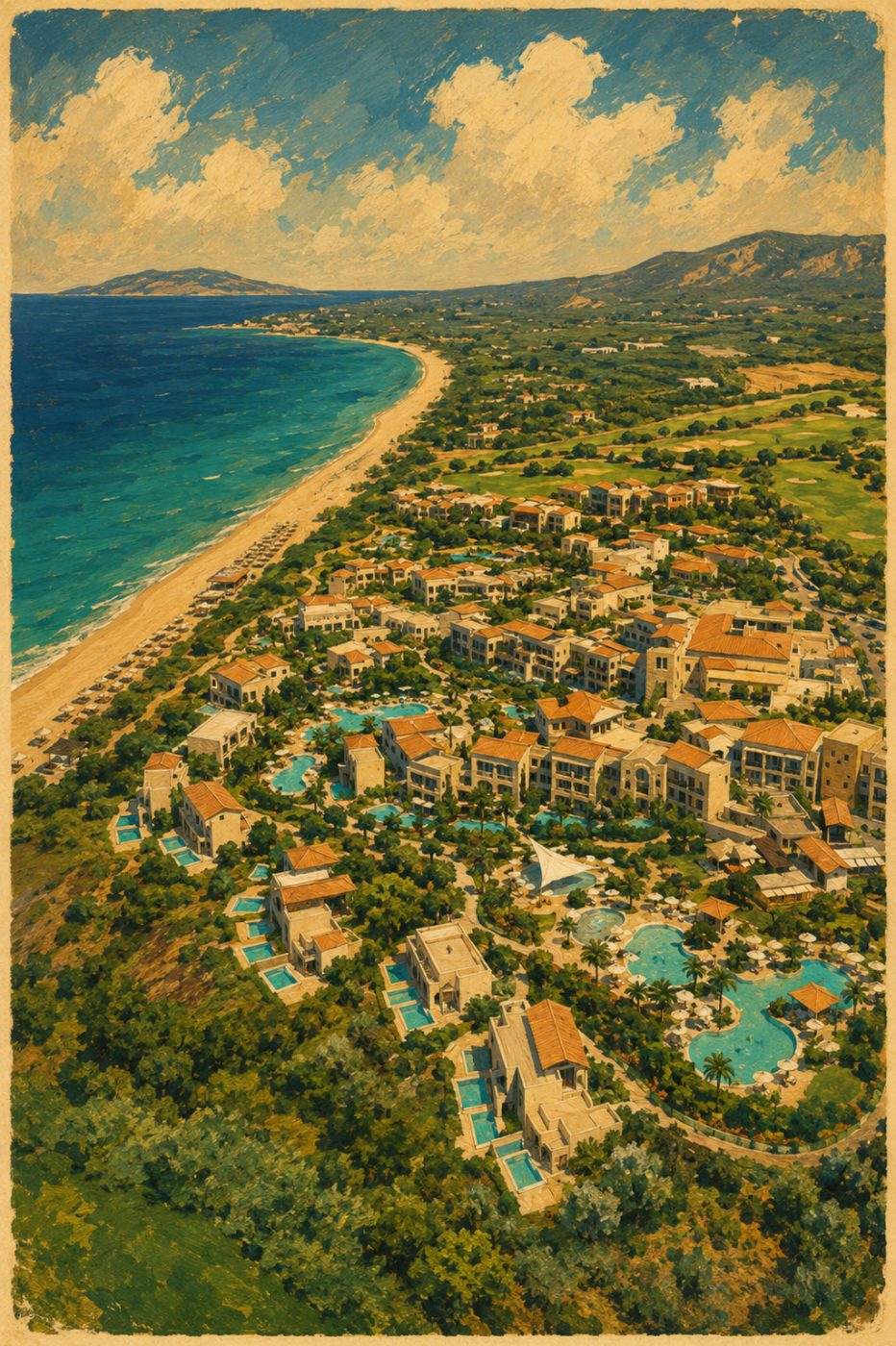
Olive groves, low hills, dunes, long sandy beaches, stone, earth and the Ionian Sea do not function merely as background. They enter the architecture, the routes, the materials, the gastronomy and the way you move through the destination.
At Mandarin Oriental, earth-sheltered villas disappear into the slope beneath planted roofs. At W, stone, wood and low-rise structures create more the feeling of a contemporary Mediterranean village than a large resort. At Navarino Dunes, building volumes remain low and greenery continues to dominate visually.
Luxury here does not try to become more impressive than the landscape.
It tries to become part of it.
And somewhere there lies the explanation for why today we speak of Costa Navarino as a destination rather than simply a luxury hotel near Pylos.
It has created a world of its own, complete enough to be a reason for travel in itself, but without shutting Messinia out of it.
Pylos, Gialova, Voidokilia, Nestor, the olive trees, the sea and the villages are still there.
And perhaps that is its greatest success.
Why Costa Navarino works for a more premium holiday
Premium here does not have only one form.
That is also its greatest difference from other high-end Greek destinations.
It can mean an earth-sheltered villa with a private pool and almost complete privacy.
It can mean a beachfront resort, golf and spa.
It can be design, music and a more social character.
It can be a large family villa where children, parents and friends have different activities during the same day.
Or it can simply mean that for one week you have more options than you need and no reason at all to use them all.
That matters.
Costa Navarino was not designed as one resort that has to fit everyone into the same style of holiday.
Its different areas and hotels allow you to choose from the start which version of premium you want.
When luxury lets the landscape remain visible
Architecture is one of the places where the philosophy of the destination becomes clearest.
There are no dominant high-rise buildings or huge volumes trying to become the new landmark of the coast.
The lines are low.
The palette revolves around stone, earth, wood and green.
In many places, planted roofs make the buildings disappear into the hills.
The olive trees were not removed to create a polished resort landscape. They became part of it.
Even the most contemporary versions of luxury do not need to announce that you are in an expensive destination.
The view, the space and the relationship with the sea do much of the work.
This creates a form of luxury that feels more grounded and less theatrical.
Where to stay and how it changes the experience
Mandarin Oriental: the most private version
If you want Costa Navarino in its quietest and most ultra-luxury form, Mandarin Oriental is the obvious starting point.
The suites and earth-sheltered villas are arranged amphitheatrically above the bay, with large terraces and, in the villas, private pools.
Here the accommodation can easily become the whole day.
Breakfast on the terrace.
Pool.
View across the bay.
Spa.
A long lunch.
And enough time not to care very much whether you leave the resort before dinner.
Luxury here lies more in quiet, space, architecture and personalised service than in a social scene.
If the aim is to withdraw without feeling isolated, this is perhaps its purest expression.
The Romanos: refined beachfront luxury
The Romanos has more the character of a sophisticated Mediterranean resort.
Sea, generous outdoor spaces, spa, golf, private-pool suites and villas close to the coast create a more classic high-end experience.
It does not have the same social energy as W or the ultra-private feeling of Mandarin Oriental.
It is more discreet.
More sea, spa, golf and a slower rhythm.
It is also perhaps the place where Costa Navarino’s relationship with the area’s Mycenaean past is most visible in the aesthetic and wider narrative of the resort itself.
W Costa Navarino: design and more social energy
W is the most contemporary version.
Music, design, pool life, beach, cocktails and more of a sense that the resort has its own social rhythm.
Here luxury is less formal.
It can begin with brunch, continue by the pool and gradually move into cocktails and dinner without you really changing setting.
The materials and architecture remain tied to Messinia, but the atmosphere is clearly more international.
For a couple or group of friends who want a premium holiday with more life around them, it is perhaps the most natural choice.
The Westin: when premium becomes family-focused
The Westin has a different mission.
Here luxury lies to a large extent in ease.
Children’s programmes, sports activities, pools, an Aqua Park, tennis, basketball and beach create an environment where a family does not have to construct the programme from scratch every day.
The children can have their own activities.
The parents can have spa, golf or time by the sea.
And everyone can meet again later.
For a family, that can be a more meaningful luxury than any design detail.
Private villas: when you want your own home within the destination
For a large family or group of friends, independent villas completely change the experience.
You no longer feel as though your holiday is divided among many separate hotel rooms.
You have a home.
Your own pool.
A large shared outdoor space.
Breakfast together.
Dinner at the villa if one evening you do not want to go anywhere.
And at the same time spa, golf, restaurants and beach remain available whenever you want them.
For a large group, this may be the most complete form of high-end accommodation at Costa Navarino.
Golf as part of the destination itself
Golf here is not just another activity on a list.
It is one of the reasons Costa Navarino acquired an international identity.
There are four different 18-hole courses and each has a different relationship with the Messinian landscape.
Sometimes the view opens towards the Ionian Sea.
Sometimes towards Navarino Bay.
Sometimes the game moves more through hills and olive groves.
If you genuinely play golf, it can be one of the main reasons for the trip.
If you do not, you can still understand how strongly it has influenced the overall design of the destination.
It is not a golf course beside a resort.
It is part of Costa Navarino’s landscape itself.
Wellness that begins in Messinia
A spa becomes more interesting when it does not simply reproduce the same international luxury wellness menu you could find anywhere.
At Costa Navarino, olive oil, honey, herbs and other local ingredients find their way into different treatments and rituals.
Anazoe Spa is the most characteristic expression of this approach.
The large space, different water and treatment environments and the connection with olive oil create an experience that has more reason to exist here than in a generic luxury hotel.
And in a destination offering so many activities, I would deliberately leave one day with none.
Spa.
Pool.
Lunch.
Sleep.
Sea.
Being able to do many things does not mean you should fill every hour.
Before Costa Navarino there was Nestor
The region does not need to invent a myth to acquire depth.
You are in Pylia.
The land of Nestor.
In the Odyssey, Telemachus arrives in Pylos searching for information about Odysseus and is received by the wise king.
A few kilometres from modern Pylos stands the Palace of Nestor at Ano Englianos, one of the most important Mycenaean palatial centres in Greece.
Here the premium trip suddenly gains another dimension.
In the morning you can walk through a Mycenaean palace associated for centuries with Homer’s world and a few hours later return to a private-pool villa.
That contrast needs little explanation.
You simply need to experience it.
For that reason, I would give the site time.
Ideally early in the morning and, if history genuinely interests you, with a good guide.
Not as just another sightseeing stop between two reservations.
Pylos: where the resort meets the place
Pylos does not need to function as “the escape from Costa Navarino”.
It is simply another chapter of the same trip.
Built amphitheatrically above the bay, with its central square, harbour, old houses and Niokastro, it has an everyday life no resort needs to recreate.
Here it is worth doing less.
Coffee in the square.
A walk by the harbour.
Niokastro.
Lunch.
And a little time with no programme.
The same bay carries another layer of history. Here, in 1827, the Battle of Navarino took place, one of the decisive moments of the Greek War of Independence.
So within a small radius, different worlds meet.
Nestor.
The naval battle.
Present-day Pylos.
And one of the most contemporary luxury destinations in the Mediterranean.
Voidokilia and Gialova: the landscape that needs no upgrade
There are experiences where a larger budget can genuinely give you something better.
And there are others where the best thing you can do is leave the place as it is.
Voidokilia belongs to the second category.
The almost perfect curve of the beach, the sand, the sea and the surrounding hills need no cabana, beach service or infinity pool.
Nearby, Gialova Lagoon is an important protected wetland, particularly valuable for migratory birds and the biodiversity of western Messinia.
This is a useful reminder on a premium trip.
Luxury does not need to be everywhere.
You can spend the afternoon in a completely natural place and return later to your private pool, a spa or a long dinner.
You do not need to turn all of Messinia into a resort in order to enjoy the resort.
Messinian gastronomy within the high-end experience
The region has one major advantage: its gastronomy had exceptionally strong raw materials long before luxury hospitality arrived.
Olive oil.
Olives.
Honey.
Vegetables.
Fish.
Wine.
Cheese.
And a cooking tradition that remains closely connected to the land.
Costa Navarino offers a broad range of restaurants and more refined gastronomic experiences, but the interesting thing is not to remain only there.
An olive-oil tasting.
Cooking with people from the region.
A table in Pylos or Gialova.
Simple fish.
A good wine.
And then, on another evening, fine dining.
Premium does not become less premium when it meets something simple.
Often it becomes more interesting.
What is really worth the larger budget
At Costa Navarino, I would first spend money on choosing the right version of the destination.
Not automatically on the most expensive room.
Do you want privacy, generous space and ultra-luxury service? Mandarin Oriental.
Do you want a refined beachfront resort? The Romanos.
Do you want design and social energy? W.
Do you want a family experience with substantial facilities? The Westin.
For a large family or group of friends, a villa may be worth more than many separate suites.
Then I would look at the outdoor space.
Private pool.
Large terrace.
View.
Garden.
Direct relationship with the sea.
In a place where much of the day happens outdoors, these matter more than an even larger interior.
And finally, I would select one or two experiences that are genuinely worth upgrading.
A major spa ritual.
Golf, if you play.
A private day at sea.
An excellent guided visit to the Palace of Nestor.
A dinner you want to remember.
The entire week does not need to function like a catalogue of luxury experiences.
The place has already created the environment.
When to go
For the climate context of the area, long-term Hellenic National Meteorological Service measurements from Kalamata are used as the nearest official reference point for coastal Messinia.
In May, the average maximum temperature is around 25°C.
It is an excellent time if you want the trip to include golf, spa, Pylos, Nestor and exploration, with the sea beginning to play a larger part in the day as the month progresses.
In June, the average maximum approaches 29°C.
It is one of the best months for genuinely using the whole destination. Beach, pool, golf and excursions can coexist much more easily.
In July and August, average highs are around 31°C.
The trip then becomes more about sea, pool and resort life. A private pool, shade and the ability to spend the hottest hours close to your accommodation become more valuable.
September remains distinctly summery, with an average maximum close to 28°C.
For a sophisticated premium trip, it is perhaps one of the periods I would consider first. The sea remains part of everyday life while the wider region of Messinia becomes much easier to use.
In October, average highs fall to around 24°C and the chances of rain increase.
Costa Navarino then changes character. More golf, wellness, gastronomy, archaeology and nature, and less of a pure beach holiday.
One of its advantages is that its season has extended well beyond the classic July and August period.
And perhaps it is precisely in the shoulder seasons that its relationship with Messinia becomes clearest.
For groups of friends
For a group, Costa Navarino works especially well when not everyone wants the same things.
Someone can play golf.
Someone can go to the spa.
Others can spend the morning by the pool.
Some can leave for Voidokilia or Pylos.
And everyone can meet again in the evening.
A large villa can be the genuinely luxurious choice here.
Not only because it has a private pool.
But because it creates a shared home within a destination that already has almost everything.
For families
For a family, it is one of the most complete high-end choices in this series.
Premium can buy something much more useful here than prestige.
Space.
Time.
Kids’ clubs.
Sports.
Beach.
Pool.
And enough activities that children do not have to follow the adults’ programme all the time.
For a multigenerational family, a larger villa makes even more sense.
Everyone can have their own rhythm without losing the feeling that you are all on holiday together.
For couples
For a couple, the key question is which Costa Navarino you want.
Mandarin Oriental for privacy, spa and plenty of time together.
The Romanos for a refined beach resort.
W for greater social energy.
And I would keep at least one day outside the resort world.
Nestor.
Pylos.
Gialova.
A long lunch.
And a return shortly before the sun goes down.
The resort is good enough to make you want to stay.
Messinia is interesting enough to make leaving worthwhile.
For solo travellers
Solo premium here works particularly well when the trip has a personal focus.
Golf.
Wellness.
Sports.
Gastronomy.
Or simply a few days in which someone else has taken care of most of the everyday details.
There is enough activity that you do not need company to fill the day.
And enough space that you can withdraw when you want none of it.
What to consider before booking
The first thing is not to think of Costa Navarino as one large hotel.
It is not.
The different areas and four resorts can create quite different trips.
So I would choose the style of holiday first and the room second.
The second is to decide how much you want to use the resort.
You can easily spend several days without leaving.
But if you do not see Pylos, Gialova, the Palace of Nestor and part of the surrounding Messinia at all, you miss exactly what makes it different from an excellent luxury resort that could be anywhere.
And third, do not try to do everything.
Golf.
Spa.
Restaurants.
Sports.
Beaches.
Archaeology.
Nature.
Wine and olive-oil experiences.
If you turn the holiday into a checklist, you lose what you paid more for.
Time.
Ταιριάζει αν
- You want a high-end trip where the resort is a genuine part of the destination.
- If you like luxury but do not want to feel that you are in an artificial world disconnected from Greece.
- If golf, wellness, gastronomy, privacy and sea can all fit into the same week.
- If you travel with people who have different needs.
- And if you are interested in the idea that luxury can be sophisticated and at the same time deeply tied to a place.
- An earth-sheltered villa.
- An old olive grove.
- A golf course over the hills.
- The Palace of Nestor.
- A glass of wine.
- And the Ionian Sea constantly in the background.
Ίσως όχι αν
- You want your holiday to happen mainly within a small village that you can know entirely on foot.
- Costa Navarino is large.
- It has different areas, resorts and experiences.
- If you want the intense social scene of Mykonos or the almost theatrical uniqueness of Santorini’s caldera, premium here has a different character.
- It is more expansive.
- More grounded.
- More private when you want it to be.
- And more closely connected to the idea that luxury does not have to replace a place in order to elevate it.
- Perhaps that is ultimately Costa Navarino’s most interesting achievement.
- It did not become an international destination because it hid Messinia behind a luxury brand.
- It became a destination because it managed to make Messinia part of the luxury itself.