
Summer · editorial guide
Mykonos: cosmopolitan glamour and privacy in the Aegean
By The Tripsenti Team
There are islands you discover, and there are islands that arrive in your imagination before you do. Mykonos belongs to the second category.
Before you see Chora, Little Venice or the first strip of white sand, you already have an image of it. Yachts in Psarou, white villas above the Aegean, long tables that begin late in the afternoon and nights that may end the following day. Mykonos has achieved something that very few Greek destinations have managed on the same scale: it has turned its own name into an international symbol of a particular kind of summer.
And yet, its luxury is not found only in the places where everyone wants to be seen.
The same Mykonos that can put you at the centre of the scene can, a few kilometres later, give you a villa behind dry-stone walls, a pool facing nothing but sea, a small cove or a table far from Chora. This alternation between visibility and privacy is perhaps its most distinctive premium quality.
It is no coincidence that for decades it has attracted people who live much of their lives in the public eye. The island’s international jet-set history stretches from Aristotle Onassis and Jackie Kennedy to figures from film, music, fashion and design who continue to return.
Some come to be where everything is happening. Others choose Mykonos precisely because it knows very well how to offer privacy to people who need it.
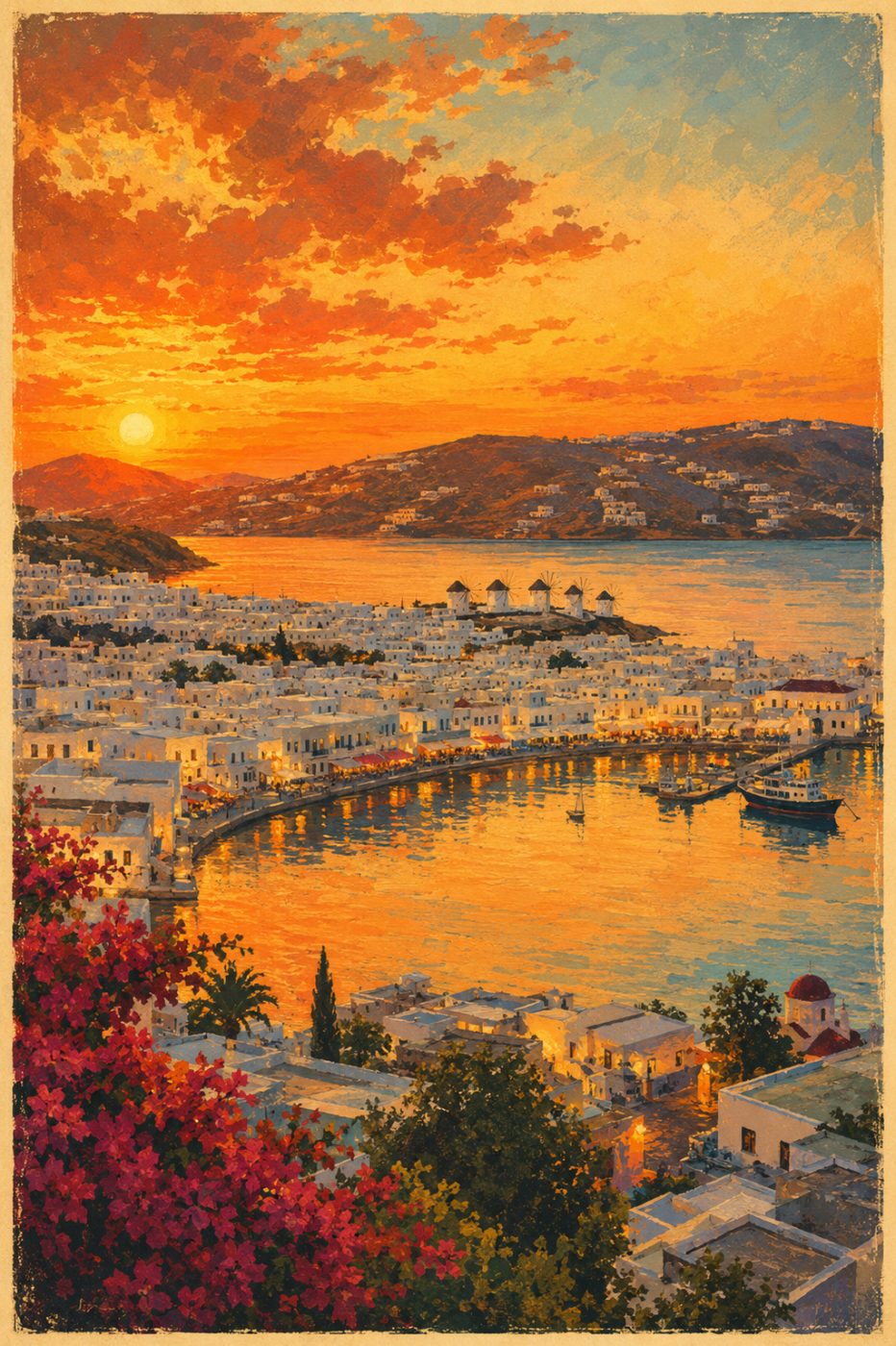
Why Mykonos works for a more premium holiday
Premium in Mykonos is about choice.
You can stay close to Chora and have restaurants, galleries, boutiques and nightlife almost outside your door.
You can choose Psarou or Platis Gialos and organise the trip around the sea, long lunches, beach life and afternoons that need no particular plan.
Or you can turn towards Agios Ioannis, Aleomandra and other more private locations, where the experience becomes more about villa, view, pool, sunset and selective nights out when you genuinely want them.
Glamour and simplicity, intense entertainment and calm, tradition and contemporary luxury can coexist within a very small geographical area.
Here, then, you do not have to decide whether you want to see people or see no one at all.
You can want both.
The island where being seen is part of the experience
There is a side of Mykonos that has no need to pretend to be understated.
Psarou has long been associated with the international jet set, yachts and a version of beach life in which the beach is simultaneously a place to swim, eat and socialise.
At Paraga, Super Paradise and other points along the south coast, the day can begin with the sea and gradually change character as the afternoon approaches.
And then there is Chora.
Matogiannia, Little Venice, the lanes around Kastro and the windmills create a setting where a simple walk can easily turn into dinner, cocktails, shopping or a night that continues far longer than you planned. Luxury boutiques, galleries, restaurants and bars are now an inseparable part of its contemporary identity.
If this is the trip you want, there is no reason to tone it down into something more “authentic”. Cosmopolitan Mykonos has been an authentic part of the island’s story for decades.
And the island where you can disappear
The other side is photographed far less.
Part of the real luxury of Mykonos lies in being able to distance yourself from all of that without having to leave the island.
A standalone villa with staff, a suite with a private pool, breakfast without a timetable, dinner on the terrace, a yacht that collects you for a day at sea or a property where much of the experience is organised before you even need to ask.
Personalised hospitality, bespoke services, private dining and private sea excursions have become part of the island’s premium identity.
There are also beaches that retain a very different character from the famous beach clubs. Myrsini, Fokos, Mersini, Lia and Kalo Livadi’s quieter reaches show a more natural and open side of Mykonos.
This is perhaps its secret for people who have the means to choose exactly how they want to experience it.
To appear when they want.
And to disappear when they choose.
Where to stay and how it changes the experience
Chora
If you want to experience Mykonos primarily as a social destination, Chora remains the centre of gravity.
In the morning it is white, bright and almost theatrical. At night it takes on a completely different energy. Small restaurants, international fashion boutiques, galleries, bars and clubs coexist within the same maze of narrow streets.
Here, premium is more about having a beautiful private base in or just above Chora, so that the night can begin and end when you decide.
Psarou
Psarou is the most unapologetically glamorous version of the island.
Yachts, beach life, dining and a social scene meet in a small bay that has for years been a reference point for the international jet set.
If you want the hours you spend on the beach themselves to be part of the event, this is one of the most characteristic places in Mykonos.
Ornos and Agios Ioannis
Here the experience can become more resort-led.
Sea, suites, spa, private pools and more reasons to spend several hours at the property itself. Agios Ioannis in particular also has views towards Delos, which changes the atmosphere as the light falls.
These are choices that suit you better if you want Mykonos close at hand without being constantly at the centre of its intensity.
More private villas
If privacy is the main priority, the logic changes completely.
You do not need to be directly above a famous beach. A standalone property with an open view, generous outdoor space, staff and the ability to organise a large part of the day without leaving may be worth much more.
This is the version of Mykonos that explains why the island can attract both people who love publicity and people who pay precisely to avoid it.
Myths before the glamour
Mykonos had myth long before it had a jet set.
According to ancient tradition, the island’s distinctive rocky formations were believed to be the tombs of the Giants killed by Heracles during the Gigantomachy. The mythical Mykonos, after whom the island was named, was the son of Anios, king of Delos.
There is another, lesser-known myth. The islets of Gyres, at the entrance to Panormos, have been associated with Ajax the Locrian. According to tradition, on his return from Troy the gods destroyed his ship and cast him into the sea from the rock on which he had taken refuge.
But the greatest mythological presence lies directly opposite.
Delos: the other great Mykonos experience
A few miles from the beach clubs and private villas lies one of the most important sacred sites of antiquity.
According to myth, Apollo and Artemis were born on Delos. The island developed into one of the most important religious centres of the ancient Greek world and is now a UNESCO World Heritage Site.
For a premium trip, it is worth treating Delos differently from a quick organised excursion.
A private or small-group boat trip that allows real time at the archaeological site and, when conditions permit, continues with swimming around Rhenia creates one of the most complete days Mykonos can offer.
In the morning you walk through a place dedicated to Apollo.
In the afternoon you are back in the Aegean.
And in the evening you can return to a completely different Mykonos.
That contrast is part of its luxury.
What is really worth the larger budget
In Mykonos, I would invest first in privacy and location.
A room with a truly unobstructed view, a villa that does not share its outdoor areas or a property where you genuinely want to spend an entire afternoon can change the trip far more than a few extra square metres.
Second comes service.
Private transfers, a concierge who handles reservations, a properly organised day at sea, in-villa dining, spa treatments and all the details that remove small pieces of daily organisation are where premium begins to have substance.
Third, I would put experiences.
Not necessarily many of them.
One genuinely excellent dinner. One day on a yacht. Delos and Rhenia. One long lunch that becomes the afternoon. One sunset you do not have to share with hundreds of other people.
In Mykonos, luxury does not need to be constantly visible in order to work.
The other Mykonos
It is also worth leaving a little room for the island behind the brand.
In Ano Mera, Panagia Tourliani remains one of the most important places in local life. The monastery dates from the 15th century and stories and traditions linked to generations of Mykonians and the island’s maritime life have been preserved around it. One tradition says sailors would pray before the icon before setting out on their journeys.
In Chora, the windmills were not built to become a photographic backdrop. They were part of the island’s economy and used the strong Cycladic winds to grind grain.
These stories make Mykonos more interesting when you have time to look beyond its obvious image.
When to go
June is one of the first periods worth considering for a more sophisticated trip. The island is in full summer operation, the days are long and the social scene is already underway, without yet reaching the intensity of August.
July and especially August are Mykonos at maximum volume. More yachts, more events, greater demand for the best restaurants and most desirable accommodation. If the trip is specifically about that energy, this is the right period.
If, however, you want luxury with more space around it, September may be even more appealing. The sea and the summer lifestyle remain, but there is more room to move between the cosmopolitan and quieter sides of the island.
And in any season, wind remains a fundamental element of Mykonos. It is the “island of the winds” not only as a nickname but as a reality of the landscape. A day on a yacht or a particular beach is best kept flexible according to conditions.
For groups of friends
Mykonos can make an excellent premium trip for a group when everyone shares an appetite for social life.
A good villa can make more sense here than several separate hotel rooms. A large shared outdoor area, a pool, breakfast or dinner at home and the possibility of having your own private space between outings completely changes the way a group experiences the island.
And then you can choose when you want to step into the scene.
For families
For a family, I would look at a completely different Mykonos from the one you see in Chora after midnight.
A seaside resort or villa, more personal space, a pool, easy access to the sea and services that reduce daily organisation can make the island far more family-friendly than its image suggests.
Here, a premium budget has real value when it buys time and ease for everyone, not simply prestige.
For couples
For couples, Mykonos may offer the greatest flexibility.
You can come for dressing up, dinners, cocktails and cosmopolitan life.
Or for a suite with a private pool, long breakfasts, the sea, spa and perhaps two nights in Chora during an entire week.
The strength is that you do not have to choose exclusively between the two.
For solo travellers
Solo and premium in Mykonos can mean something very different from isolation.
It is a destination where you can be on your own without feeling outside the social life. You can spend the morning at the hotel, the afternoon on a beach and the evening alone in Chora without the setting necessarily requiring company.
For someone who wants to combine independence with social energy, that is a significant advantage.
What to consider before booking
First decide which Mykonos you want.
If you want to be inside the social scene, it is worth staying close to it. If you want privacy, do not pay a premium simply for a famous postcode. Look at orientation, view, distance from neighbouring properties, outdoor space and how genuinely private the pool or terrace is.
Second, in high season the best things require foresight. A genuinely excellent room, a particular villa, a popular dinner reservation or the right day at sea are not always experiences that are ideally arranged at the last minute.
Third, do not assume that more expensive automatically means quieter. Some of the island’s most premium locations are precisely where the greatest social energy is concentrated.
In Mykonos, real luxury lies in knowing when you want the lights on you and when you want no one around you at all.
Ταιριάζει αν
- You want the holiday to feel like an occasion.
- If you enjoy dressing for the evening, turning lunch into an event, devoting an entire day to the sea and returning to accommodation that is part of the experience rather than simply a place to sleep.
- It also suits you if you love contrast. Glamour and bare Cycladic landscape. Champagne and dry-stone walls. International jet set and ancient Delos only a few miles away.
Ίσως όχι αν
- You want luxury to be strictly understated and you do not want the social scene to be part of your trip at all.
- You can certainly isolate yourself in Mykonos. But if you have no interest in fashion, dining, nightlife, yacht culture or the island’s distinctive social energy, you may be paying for a large part of the Mykonos premium that you simply do not need.
- Mykonos is more interesting when you do not try to turn it into something else.
- It had myths before celebrities, Delos before yachts and Cycladic landscape behind the glamour. But it also has the glamour. And for more than half a century, that too has been part of its own mythology.