
Summer · editorial guide
Santorini: the luxury of the world’s most famous sunset
By The Tripsenti Team
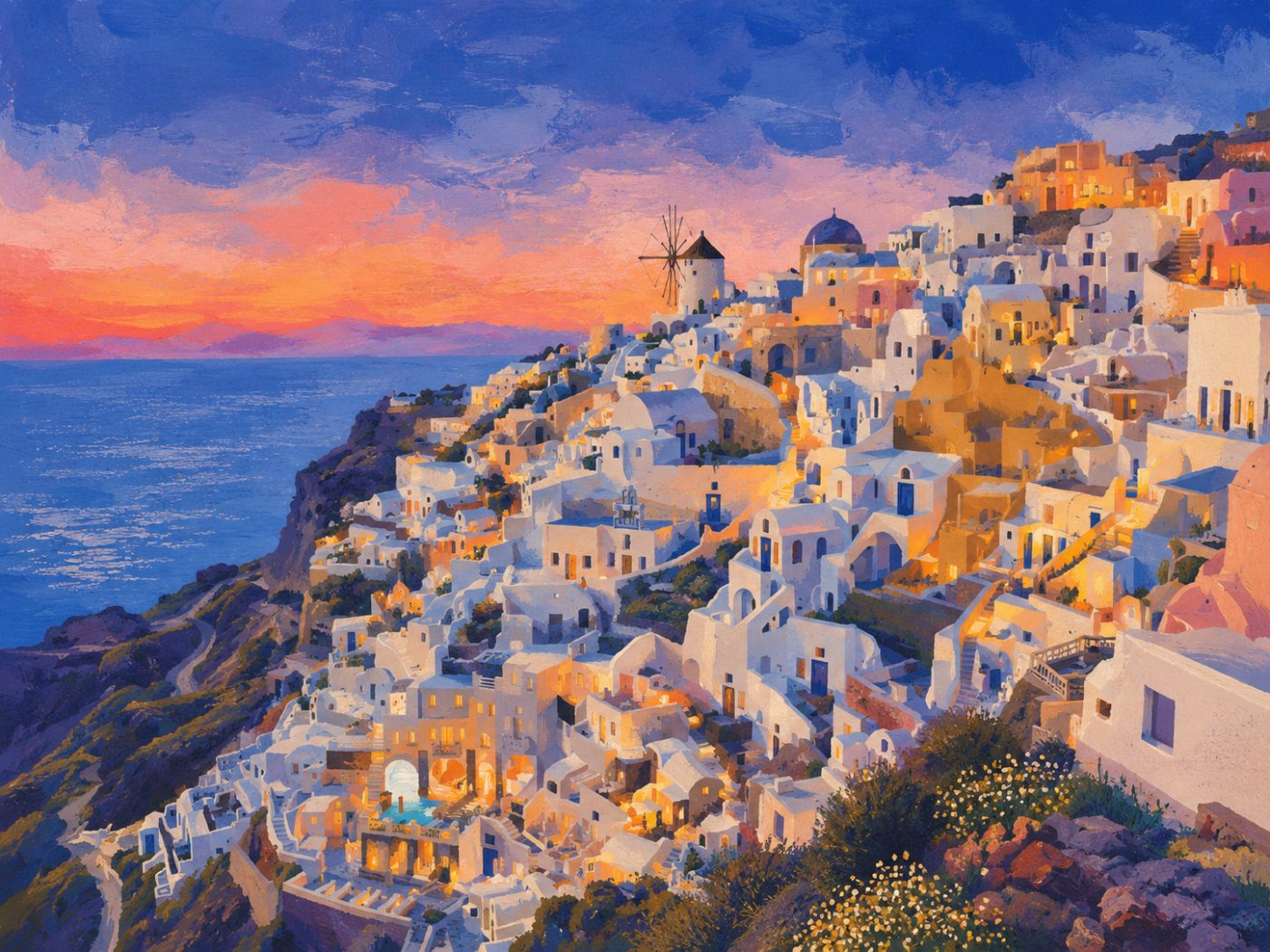
Santorini is one of those places where the view does not simply accompany the trip. It is part of the reason you come.
The caldera opens hundreds of metres below the villages, the volcano and Thirasia lie opposite and the light keeps changing across the cliffs until the sun disappears into the Aegean.
In a place like this, premium does not begin with the size of the room. It begins with where that room is.
A cave suite on the caldera, a genuinely private terrace, a plunge pool above the sea, breakfast without having to leave your room and a sunset you do not have to compete for among hundreds of other people.
That is perhaps the most characteristic form of luxury in Santorini: having one of the Mediterranean’s most recognisable landscapes in front of you and, for a few hours, making it feel almost private.
Why Santorini works for a more premium holiday
In Santorini, a larger budget can genuinely change the way you experience the landscape itself.
You are not paying only for more square metres or additional amenities. You may be paying for a front-row position on the caldera, an unobstructed view, a private pool, more outdoor space or a cave suite where the architecture is part of the experience.
That is why accommodation deserves more attention here than on an island where you know you will return to your room only to sleep.
In Santorini, you may actually want to stay there.
Have breakfast on the terrace.
Spend the hottest hours by the pool.
Open a bottle of Assyrtiko in the afternoon.
Watch the sunset without having to go anywhere.
And then head out for dinner once the island has moved from golden light into its evening atmosphere.
Luxury here is more personal and more connected to the moment.
The luxury of not having to chase the sunset
Oia’s sunset is one of the most recognisable elements of Santorini’s image.
As the hour approaches, the lanes around the Castle fill, viewpoints are occupied early and the entire village seems to wait for the same moment.
But there is another version.
You are already on your terrace.
You have a table for two, a glass of wine and the caldera in front of you.
You do not have to fight for a place or leave the moment the sun disappears.
On a genuinely high-end trip to Santorini, this privacy may be worth more than any additional amenity.
The best position is not always the place where everyone is.
It may be the one that, for a few hours, belongs only to you.
Where to stay and how it changes the experience
Oia
Oia is the iconic version of Santorini.
Cave houses, white façades, blue domes, captains’ mansions, small galleries and the caldera opening below the village.
This is where I would stay if I wanted the trip to feel like an occasion from the very first moment.
A honeymoon.
An anniversary.
A proposal.
Or simply a few days when you want to allow yourself a room you would not choose on an ordinary trip.
Oia also has the island’s greatest international recognition. So if genuine privacy is the priority, it is not enough for a property to describe itself as a “luxury cave suite”.
Look at exactly where the terrace sits, whether a public path passes in front of it, how close neighbouring pools are and whether the view is genuinely unobstructed.
Imerovigli
If Oia is more iconic, Imerovigli may be the more refined version of the caldera.
It stands high above the sea, opposite the volcano and Thirasia, with Skaros Rock dominating the view in front of the village.
Here luxury can be quieter.
Suites built into the cliff, private pools, large terraces and less need to be constantly inside the flow of visitors.
For a couple who wants high-end Santorini mainly for privacy, views and time together, Imerovigli is one of the first places worth comparing with Oia.
Firostefani
Firostefani lies between Fira and Imerovigli and offers an interesting balance.
You have the caldera in front of you but remain close to the largest concentration of restaurants and evening life in Fira.
It suits you if you want a premium room with a view but do not want the entire trip to happen inside the suite.
You can watch the sunset from the terrace and be at dinner or a cocktail shortly afterwards without the trip becoming completely resort-led.
Pyrgos and Megalochori
Here a different form of luxury begins.
Pyrgos climbs around its old Kasteli, with traditional houses, churches and views opening across much of the island.
Megalochori sits within Santorini’s wine landscape, with historic homes, old wine cellars and a small central square.
If you want more understated luxury, both places deserve serious consideration.
A historic villa.
An old cave house converted into boutique accommodation.
A courtyard instead of an infinity pool above the caldera.
A wine tasting in the afternoon and dinner in the village.
Here luxury has more to do with a sense of place and less with being inside Santorini’s most recognisable photograph.
Akrotiri
Akrotiri is an interesting option if you want more space and greater distance from Oia and Fira.
The landscape is open, the archaeological site is nearby and from many points the view looks back towards the caldera.
For a villa-led trip, more privacy or for someone who wants calm more than a social scene, it can offer a very different high-end experience.
An island born from a volcano
The very feature that creates Santorini’s greatest premium today is the result of an enormous natural catastrophe.
The major volcanic eruption of the Late Bronze Age transformed the island and created the form of today’s caldera.
The sea flooded the volcanic basin and left around it the steep, multicoloured cliffs on which Oia, Imerovigli, Firostefani and Fira now stand.
That means the view for which you now book a suite months in advance has a history stretching back thousands of years.
It is not simply beautiful.
It has drama.
And the more you understand what you are looking at, the more the way you see the caldera changes.
Akrotiri: a city beneath volcanic ash
Long before cave suites and sunset dinners, Santorini was home to a highly developed city.
Prehistoric Akrotiri was one of the most important centres of the Aegean during the Bronze Age.
Multi-storey buildings, streets, frescoes, pottery and objects of everyday and luxury use reveal a society with trading links and a high level of organisation.
Volcanic ash buried much of the settlement and at the same time contributed to its exceptional preservation.
Santorini has often been linked in modern imagination with the myth of lost Atlantis. There is no archaeological evidence that Thera was Plato’s Atlantis.
But the image of a prosperous civilisation struck by a massive volcanic disaster was enough to create one of the island’s most persistent modern legends.
And yet the real history of Akrotiri is already impressive enough not to need the myth.
Before it became Santorini, it was Kallisti
There is also an older tradition surrounding the island itself.
Ancient sources record the name Kallisti, “the most beautiful”.
Later the island became associated with Theras, from whom the name Thera derives.
The present name Santorini appeared much later and is linked with Saint Irene.
The names changed.
The idea that the island possessed something unusually beautiful remained.
And when you are on the caldera shortly before sunset, the ancient “Kallisti” feels almost excessively appropriate.
What is really worth the larger budget
In Santorini, I would put the view and private outdoor space first.
Not simply the phrase “caldera view” in the description.
I would want to know exactly what I can see from the room, whether the terrace is exclusively mine, whether public paths pass in front of it and whether the pool is genuinely private.
On an island built vertically into a cliff, these things matter much more than they appear to in photographs.
Second, I would put the suite itself.
Cave rooms are not simply a contemporary design trend. They are connected to the island’s traditional architecture and the use of its volcanic earth.
If you are going to pay more here, it is worth choosing accommodation that feels as though it belongs to Santorini rather than somewhere that could exist in any luxury destination.
And third, I would put private experiences.
A sunset without crowds.
A private dinner.
A wine tasting with time to enjoy it.
A day by boat inside the caldera.
Not more things.
Better versions of a few things.
The caldera from the sea
There is one place where it is worth leaving even the best terrace.
The sea.
From inside the caldera you understand the scale of the landscape differently. The white villages become small lines at the top of the volcanic cliffs, and the relationship between Thera, Thirasia, Palea Kameni and Nea Kameni becomes much clearer.
For a high-end trip, a private or small-scale sailing experience is one of those occasions when the additional budget can make a meaningful difference.
Not because you need the largest yacht.
But because you can let the day move at your own pace.
Swimming.
The sea.
A long lunch.
Thirasia.
And the return as the light changes across the cliffs of the caldera.
Sunset from the sea is a completely different experience from sunset in Oia.
And it is worth knowing both.
Wine from volcanic soil
If there is one experience that definitely deserves a place in a sophisticated trip to Santorini, it is wine.
The island has one of the most distinctive vineyards in the Mediterranean.
Volcanic soil, drought and strong winds shaped a vineyard very different from those you see on mainland Greece.
The vines are traditionally trained low to the ground in characteristic basket shapes known as kouloura, so the grapes are protected from wind and sun.
Assyrtiko is the great protagonist.
Mineral, with intense acidity and a character directly connected to the volcanic terroir.
And then there is Vinsanto, the sweet wine made from sun-dried grapes with a deep relationship to the island’s winemaking history.
Vineyards and wineries lie around Megalochori, Pyrgos, Exo Gonia and other parts of the interior.
For a premium trip I would prefer one good tasting with a small selection of wines, time and someone who can genuinely explain the vineyard rather than rushing from winery to winery.
In Santorini, wine is not simply an activity.
It comes from the same volcanic landscape you see from your terrace.
And the food can stand beside the view
In a place like Santorini there is always the risk of paying more for the table than for what is on it.
That is why it is worth choosing carefully.
The island now offers everything from traditional tavernas to creative high gastronomy and tasting menus.
At the same time, it has very specific local ingredients.
Fava.
Small Santorini tomatoes.
Capers.
White aubergine.
And, of course, the wines of the volcanic vineyard.
A good fine-dining dinner on the caldera can be part of the trip.
But I would leave equal room for a simpler meal with local products and Assyrtiko in a village or beside a winery.
Premium does not mean every evening has to be a tasting menu.
It means being able to decide which evening is genuinely worth turning into an event.
When to go
May is especially interesting if you want Santorini more for the caldera, villages, Akrotiri, wine and food. Average temperatures reach around 25°C during the day and sit around 16°C at night.
It is an excellent time to get to know the island without the greatest intensity of midsummer.
In June, the mean high rises to around 29°C and the low to 20°C.
For a premium trip, it may be one of the best combinations. Full summer atmosphere, long days and plenty of time for terraces, the sea and sailing.
In July, the mean high is around 32°C and the low around 23°C.
This is when a genuinely good suite becomes even more valuable. If you have a private pool, shade and an outdoor area where you actually want to stay, you do not need to spend the hottest hours moving from sight to sight.
August is similar and is the period when visitor numbers are at their highest.
If you travel then, privacy, good organisation and having a place you genuinely want to return to become even more valuable.
September remains clearly summery, with a mean high of around 29°C and a low close to 20°C.
If you want Santorini’s high-end element with a little more space around it, it is one of the first months I would consider.
In October, average values fall to around 24°C during the day and 16°C at night.
The trip becomes more about caldera, wine, gastronomy, villages and culture, while beach time depends more on the specific weather conditions.
For groups of friends
For a group, Santorini works best when the aim is not exclusively intense nightlife.
A large villa or a small complex of suites with a shared private outdoor area can become the real centre of the trip.
Late breakfast.
Pool.
Wine tasting.
A day on a boat.
A long dinner.
And plenty of time together without having to search for the next activity every day.
If you want more evening energy, Fira is the area I would include more in the plan.
For families
Premium Santorini for a family requires a different choice of accommodation from honeymoon Santorini.
Many traditional caldera properties have numerous steps, steep sections, small terraces and plunge pools designed more for couples.
So here I would prioritise space, safe layout, a larger suite or villa and accommodation that genuinely works for the children’s ages.
The view remains important.
But with a family, real luxury is being able to enjoy it without the setting requiring constant additional attention.
For couples
This is Santorini in its natural environment.
Honeymoon, anniversary, proposal or simply a trip you want to feel different from ordinary summer holidays.
A cave suite.
A genuinely private pool.
Breakfast on the terrace.
A day at sea.
A wine tasting.
And one dinner for which you have left the entire evening free.
Few Greek destinations can make the room itself such an important part of a romantic trip.
For solo travellers
Solo luxury in Santorini can be extremely rewarding if you enjoy beautiful surroundings on your own.
A good room on the caldera, a wine tasting, Akrotiri, a long dinner and an afternoon with no plan can fill the trip without requiring a constant social scene.
If, however, you want more people around you, Fira will probably suit you better than an isolated suite in Oia, Imerovigli or Akrotiri.
What to consider before booking
In Santorini, I would ask one question before all the others:
How important is the caldera really to me?
If it is the main reason you are coming, it is worth investing in it.
If, however, you know you will spend most of the day in wineries, villages, beaches and exploring the island, you may not need to pay the absolute caldera premium every night.
Second, I would look very carefully at privacy.
Two suites may both be described as “private pool with caldera view” and offer completely different experiences.
At one property the terrace may be genuinely secluded.
At another, a path may pass directly in front of it or you may see and be seen from neighbouring pools.
Third, I would look at the steps.
The caldera’s architecture is impressive precisely because it is built on very steep terrain. An excellent room may require a considerable number of steps to reach.
And finally, I would not pay more simply because the address says “Oia”.
A better room in Imerovigli, an excellent villa in Akrotiri or a historic property in Megalochori may give you a much more personal luxury experience.
In Santorini, premium is not simply the address.
It is your relationship with the landscape.
Ταιριάζει αν
- You want a trip that feels genuinely special.
- If you like the idea that the room itself is part of the destination.
- If the view, architecture, wine, gastronomy and a slow sunset matter more to you than a long list of different beach clubs.
- If you want luxury that can be impressive and at the same time very personal.
- And if you believe that one of the best moments of a holiday can simply be not going anywhere.
Ίσως όχι αν
- You want your premium trip to revolve mainly around large sandy beaches and all-day beach life.
- Santorini has beaches, and they have a very distinctive volcanic character, but the sea here is part of a larger experience.
- Also, if the caldera view does not particularly move you, a significant part of the premium you pay in Oia and Imerovigli may simply not be valuable to you.
- Santorini is not luxury only because it has expensive hotels.
- It is luxury because it lets you experience one of the Mediterranean’s most dramatic landscapes in a deeply personal way.
- A cave suite.
- A terrace above the caldera.
- A glass of Assyrtiko.
- And the world’s most famous sunset happening in front of you without you needing to do anything else.